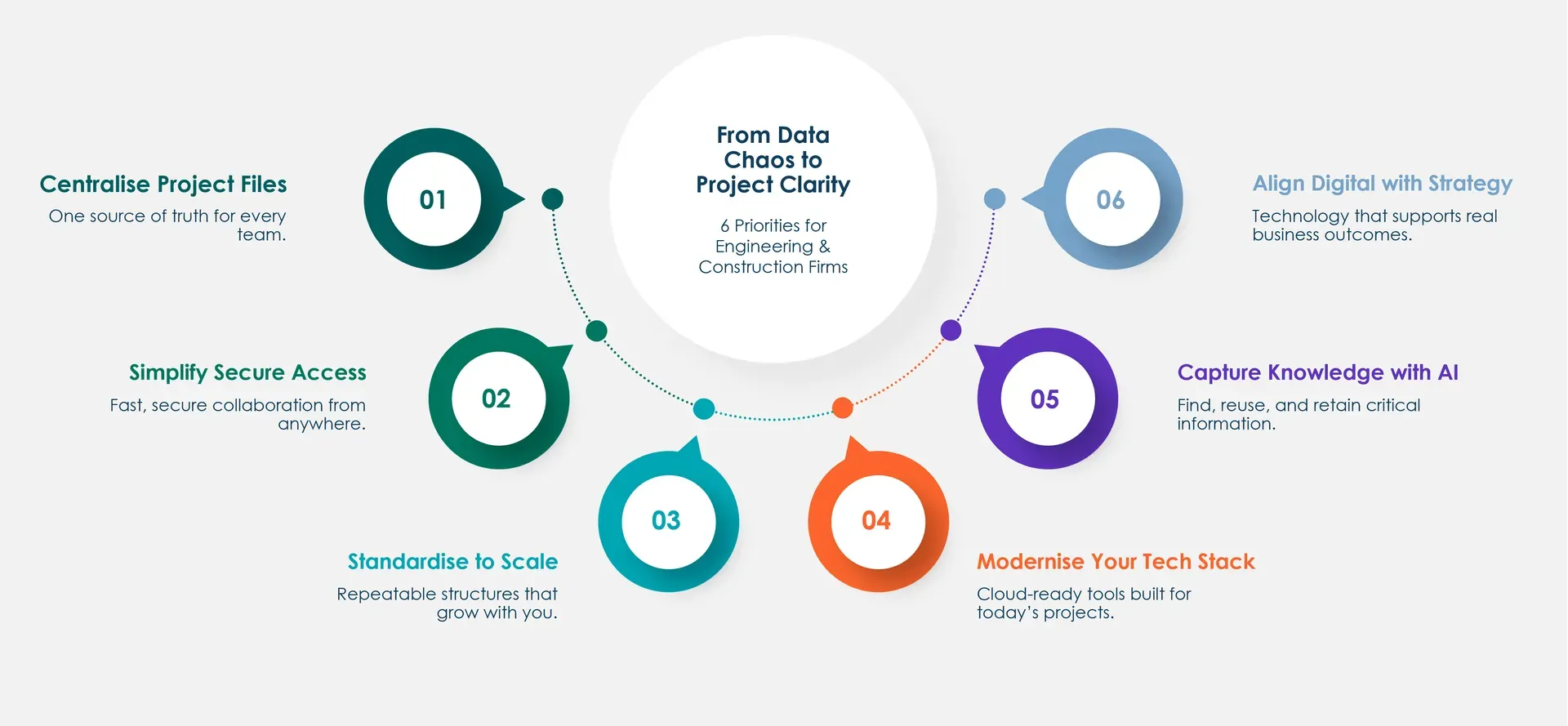
In today’s fast‑paced AEC industry, project teams manage enormous amounts of data across dispersed sites, partners, and systems. Yet many organisations still face fragmented workflows, inconsistent structures, and outdated ways of working. These issues slow down collaboration, increase rework, and create unnecessary risk.
This article outlines six key priorities that help engineering and construction firms eliminate data chaos and build more streamlined, resilient, and connected operations. Each priority represents a practical step toward stronger project delivery and better business alignment.
1. Consolidate File Workflows Across Teams
One of the most persistent challenges in the industry is data fragmentation. Project files scattered across shared drives, emails, local storage, or disconnected cloud tools. This patchwork makes it hard for teams to stay aligned and often results in duplication, delays, and confusion.
To bring order and consistency:
- Implement a centralised data hub for both project and business files
- Standardise folder structures and file naming conventions
- Integrate with tools your teams already use to reduce friction
- Maintain consistency through staff training automation

2. Simplify and Secure Remote Access
As hybrid working becomes standard, providing secure and straightforward remote access is more important than ever. Traditional VPNs can introduce latency and complexity, slowing teams down.
To enhance remote collaboration:
- Adopt secure cloud-based platforms with role-based permissions
- Implement ransomware detection and rapid recovery protocols
- Reduce reliance on heavy or complex access systems and speed up onboarding and daily work
3. Create Repeatable Structures to Scale
With fast-moving projects, inconsistent data structures and processes can quickly become obstacles. Repeatable frameworks allow organisations to scale more predictably and reduce the time spent recreating basic organisational structures for each new job.
Recommended steps include:
- Building reusable templates for folder structures and permissions
- Automating metadata tagging and version control
- Reinforcing best practices through onboarding and refresher training sessions
4. Reduce Reliance on Legacy Systems
Many firms still depend on tools and systems that no longer meet the speed, security, or flexibility required for modern construction projects. These legacy solutions often become bottlenecks that limit collaboration and slow down decision‑making.
To modernise operations:
- Assess existing systems for security, performance, and compatibility
- Phase out outdated technology in favour of scalable cloud-based platforms
- Plan transitions that minimise disruption while improving performance

5. Use AI to Preserve Knowledge and Improve Access
With shifting roles, staff turnover, and large volumes of documentation, valuable project knowledge is easily lost or buried. AI tools can help capture, organise, and surface essential information across the lifecycle of a project. This ensures that expertise remains accessible across teams, helping firms maintain continuity, accelerate onboarding, and reduce reliance on individual memory.
Practical ways to leverage AI:
- Automatically tag and classify files
- Use AI-powered search to improve discoverability
- Generate summaries for lengthy documents to speed up comprehension
6. Align Digital Practices with Business Goals
IT is no longer just a support function – it must actively contribute to strategic business outcomes. When approached intentionally, modern digital practices can accelerate project delivery, lower operational costs, and strengthen organisational resilience.
To ensure alignment with business goals:
- Involve digital and data stakeholders early in project planning and decision‑making
- Use KPIs tied to real project and business outcomes (not just tech metrics)
- Prioritise investment in platforms and processes that improve agility, collaboration, and long‑term value